
A Framework for Measuring, Managing, and Improving Marketing Profitability
This article revisits and updates the CMO Guide to Marketing ROI, originally published in 2009. The original white paper is available for download below. Updated November 2026.
Marketing ROI is not just about proving marketing's value. It's about continuously improving it.
Marketing leaders face a fundamental challenge: determining which investments generate incremental business value and how to make those investments more profitable.
While marketing organizations have access to increasingly sophisticated data, analytics, and measurement technologies, the greatest value comes from turning those capabilities into better decisions.
Marketing return on investment (ROI) provides a financial framework for evaluating marketing effectiveness, identifying opportunities for improvement, and aligning marketing strategies with business outcomes.
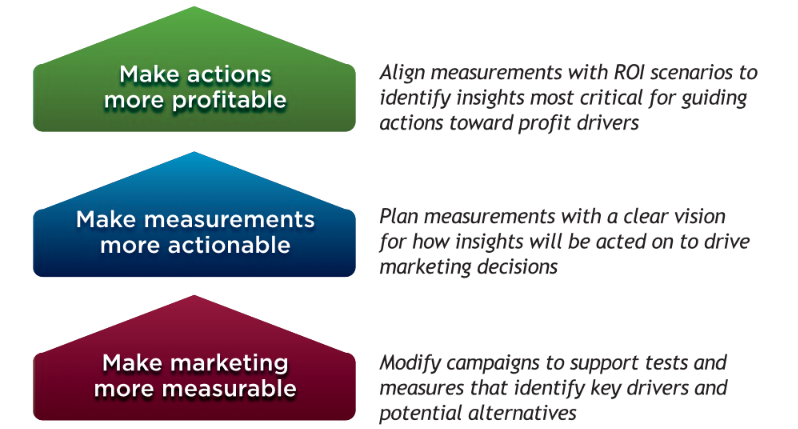
Originally introduced in Lenskold Group's CMO Guide to Marketing ROI, our approach emphasizes three interconnected disciplines:
Manage and assess ROI drivers.
Plan and execute high-impact measurements.
Use insights to develop and deliver smarter marketing.
Together, these disciplines create a continuous process for improving marketing performance and profitability.
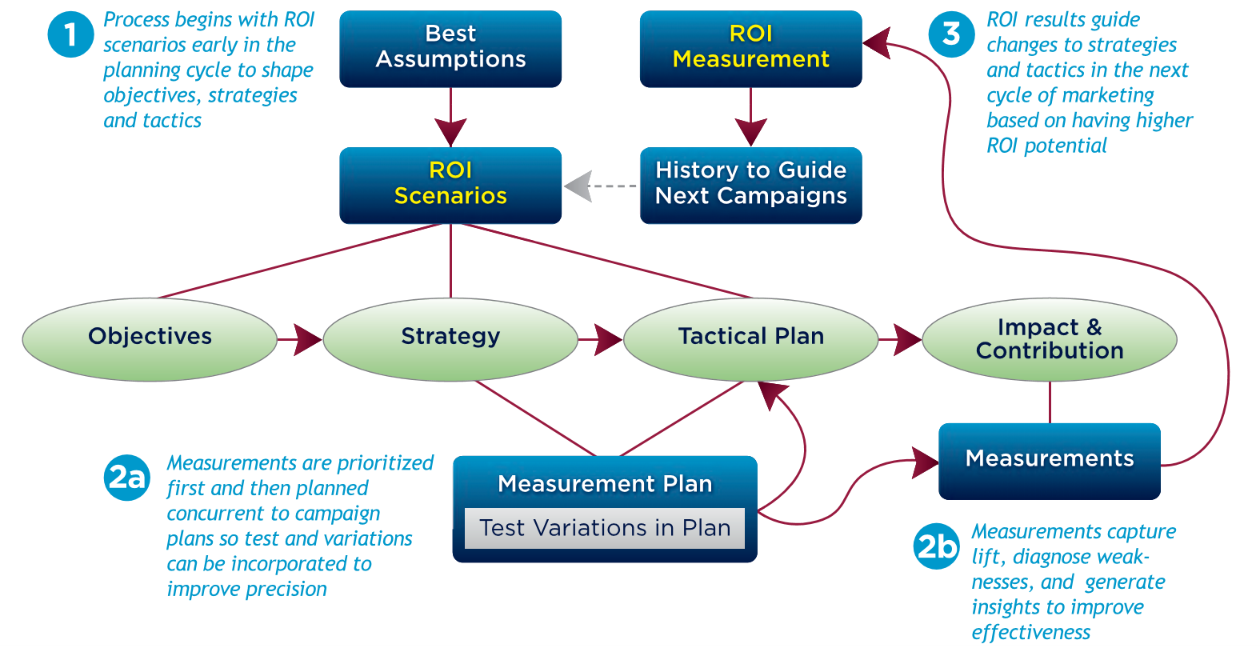
1. Manage and Assess Marketing ROI Drivers
Effective marketing ROI management begins with understanding the financial drivers of marketing performance.
Marketing investments generate value by influencing customer behaviors that ultimately produce incremental sales, revenue, and profit.
The fundamental calculation is:
Marketing ROI = (Incremental Profit − Marketing Investment) ÷ Marketing Investment
Incremental profit should reflect the financial contribution generated by marketing, accounting for relevant margins and costs.
This distinction matters because revenue growth does not necessarily translate into profitable growth.
A campaign generating substantial sales may produce disappointing financial returns if acquisition costs are high, margins are low, or sales would have occurred without the marketing investment.
Use ROI Scenario Planning to Improve Decisions
ROI analysis should begin before marketing budgets are committed.
Scenario planning allows marketers to evaluate the financial potential of alternative strategies and tactical approaches.
For example, marketers can explore how changes in the following factors influence profitability:
Target audience selection and customer value.
Conversion rates throughout the purchase funnel.
Marketing investment levels and operating costs.
Product mix, margins, and promotional offers.
Customer retention, repeat purchases, and lifetime value.
Comparing scenarios helps identify which improvements offer the greatest potential financial returns.
It also strengthens the business case for marketing investment by connecting proposed spending to expected business outcomes.
The objective is not simply to calculate ROI. It is to identify how ROI can be improved.
2. Plan and Execute High-Impact Marketing Measurements
Marketing organizations often have extensive reporting capabilities but limited insight into the incremental business impact of their investments.
Impressions, clicks, engagement, and other activity metrics can help diagnose performance. However, they do not independently establish marketing's contribution to sales or profitability.
Effective measurement begins by identifying the business decisions that need to be made.
Start with Decisions, Not Metrics
A strategic measurement plan should address questions such as:
Should we continue this investment?
Measure the incremental business contribution generated by the campaign or initiative.
Should we increase or decrease spending?
Assess how incremental returns change across different investment levels.
Which marketing tactics contribute the greatest value?
Measure the incremental impact of individual tactics and their interaction with other marketing activities.
How can campaign effectiveness be improved?
Test alternative audiences, messages, offers, and campaign designs.
Where are the greatest opportunities for profitable growth?
Analyze customer segments, conversion patterns, margins, and customer value to identify opportunities with meaningful financial potential.
Match Measurement Methods to Business Questions
Different measurement approaches offer different strengths.
Basic tracking and performance reporting provide valuable operational insights but can overstate or misrepresent incremental marketing impact.
More advanced approaches include:
Controlled experiments and incrementality testing.
Marketing mix modeling.
Statistical analysis of marketing and business performance.
Customer and conversion analytics.
Financial modeling and ROI scenario analysis.
The appropriate methodology depends on the business question, available data, marketing activity, and the precision required.
Often, combining multiple measurement approaches provides more useful insights than relying on a single methodology.
Design Marketing to Be More Measurable
Measurement should not be an afterthought.
When measurement planning occurs alongside campaign development, marketers can incorporate test designs, variations in spending, and other elements that improve the quality of the resulting insights.
The goal is to generate information that supports better future decisions—not simply produce reports documenting past performance.
3. Use Insights to Develop and Deliver Smarter Marketing
Marketing ROI improves when measurement insights lead to changes in strategies, investments, and execution.
This is where analytics delivers its greatest business value.
Rather than focusing exclusively on media channel efficiency, marketers should identify the opportunities that can generate the largest improvements in financial performance.
Where Are the Biggest Opportunities to Improve Marketing ROI?
Target higher-value customers.
Customer segments differ in their purchase potential, profitability, and long-term value. Better targeting can improve conversion rates while increasing the financial contribution generated by each sale.
Improve conversion rates at critical stages.
Small improvements near the end of the purchase funnel can produce substantial financial gains, particularly when significant marketing investment has already been made to generate qualified prospects.
Integrate marketing activities across the customer journey.
Marketing tactics often work together. Understanding these interactions helps organizations improve the effectiveness of their combined investments.
Reduce investment in low-potential opportunities.
Not every prospect or customer segment warrants the same level of marketing investment. Better qualification and resource allocation can improve overall profitability.
Optimize offers and promotional investments.
Discounts and incentives may increase sales while reducing margins. Evaluating their incremental contribution helps identify more profitable promotional strategies.
Improve efficiency without sacrificing effectiveness.
Operational efficiencies can free resources for higher-impact marketing investments.
Build a Continuous Improvement Process
Marketing optimization should be an ongoing discipline.
A productive cycle includes:
Identify potential improvements through ROI scenarios and analytics.
Prioritize opportunities based on expected financial impact.
Test alternative strategies and tactics.
Measure incremental outcomes.
Apply insights to improve future marketing decisions.
This process reduces reliance on assumptions and encourages disciplined experimentation.
Over time, organizations build a stronger understanding of what drives profitable growth.
4. Build Organizational Capabilities to Manage Marketing ROI
Successful marketing ROI management requires more than analytical tools.
Organizations need processes, resources, and leadership commitment that make financial accountability and continuous improvement part of everyday marketing decisions.
Five capabilities are particularly important:
Standardized financial analysis
Consistent ROI calculations and financial assumptions allow marketing initiatives to be evaluated on a comparable basis.
Integrated data and analytics
Marketing, sales, customer, and financial data should support a comprehensive view of business performance.
Effective measurement technologies
Modern analytical tools can increase measurement precision, automate reporting, and accelerate the development of actionable insights.
Analytical and financial skills
Marketing teams need the capabilities to interpret measurement results and translate them into decisions that improve performance.
A culture of continuous improvement
Leadership must establish expectations that insights will be acted upon—not merely presented in reports.
The CMO plays a critical role in aligning marketing, finance, sales, and other stakeholders around common business objectives.
From Measuring Marketing ROI to Improving Marketing Profitability
Marketing ROI should be viewed as a management discipline rather than an isolated financial metric.
The most successful organizations use ROI analysis to guide investment decisions, measurement to understand incremental business impact, and continuous optimization to increase the financial value of marketing.
The opportunity is not limited to proving that marketing works.
The greater opportunity is discovering how marketing can work better.
Download the Original CMO Guide to Marketing ROI
This article is adapted from Lenskold Group's original 2010 white paper, CMO Guide to Marketing ROI, part of the Marketing Profitability Management Series.
The original 16-page publication provides additional detail on ROI scenario planning, measurement methodologies, organizational implementation, and practical techniques for improving marketing profitability.
[Download the Original CMO Guide to Marketing ROI (PDF)]
Originally published in 2010. Webpage content refreshed in 2026 to reflect enduring marketing ROI principles and contemporary measurement approaches.
Put Marketing ROI Insights into Action
Lenskold Group helps organizations connect marketing measurement with business performance through marketing analytics, media effectiveness measurement, ROI optimization, and performance dashboards.